

Revealed: Fascinating stories from Kilkenny of 1926 comes to life from pages of newly released Census

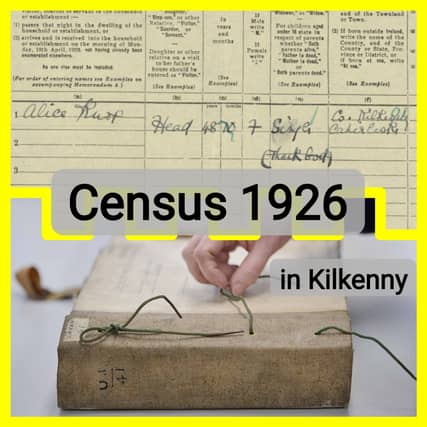

Who lived in Kilkenny 100 years ago?
On April 18, 1926, the first census of an independent Irish state was undertaken. Across the 26 counties over 700,000 census forms were completed by, or on behalf of, the 2,971,992 people living in the Irish Free State. But what can we know of the lives that they led?
A century later, with the release of the 1926 census by the National Archives on 18 April 2026, those forms came alive again – revealing a nation in transition and a people forging their identity in the early decades of independence.
The 1926 census is a treasure trove of information not only about Saorstat Eireann, but also about Kilkenny, city and county, just on the edge of our living memory.
From society leaders to the less fortunate, this census reveals all aspects of Kilkenny society a century ago.
The population of the county was 70,990, of whom 96% were catholic and 10% described themselves as Irish speakers.
Outside of the city, the most densely populated areas were Castlecomer, followed by Graignamanagh and Thomastown, then Callan, Freshford and Urlingford.
Mayor of Kilkenny in 1926 was the War of Independence hero Peter De Loughry. The census shows him living on Parliament Street and his profession listed as ‘iron founder, hardware merchant and motor garage owner.’ He lived there with his wife, Winifred, two sons, three daughters and a servant.
Meanwhile, the census also recorded ‘visitors’ to the local area on the night of the census.
At the home of Sir Otway Fortescue Luke Wheeler Cuffe, at Lyrath House, a ‘boarder’ was being hosted – Baroness Pauline Harriet Prochazka (83) from Prague. There were also visitors: Dorothy Melicent Price, who had been born in Burma, and teenage ‘cousins’ Edward Bowen Cottingham and Elizabeth Myrtle Cottingham who were students at Harrow and Royal Bath schools.
There were two ‘industrial schools/ reformatory schools’ in the city, detailed in the 1926 census, as well as one, what was then called, ‘mental asylum.’
The ‘Kilkenny District Lunatic Asylum’ was located in Maudlinsland, where St Canice’s Hospital is now located. In 1926 the first person listed there was Dr Louis Buggy, the ‘medical superintendent.’ He lived there with his wife, son and two servants. Patrick Joseph Cassin was the assistant medical officer.
An ‘E Downey’ was the matron, who also had a servant, and there was a ‘gatekeeper.’
There were 44 ‘attendants’ there and 188 ‘inmates’.
St Joseph’s Industrial School for Girls was a busy community home. While most residents were teenagers, one was as young as two. There were 16 ‘members of the community’ (nuns) with a ‘Superioress’ at their head, 113 ‘schoolgirls,’ 20 ‘laundresses’ (older teenagers) as well as ‘packers in laundry,’ ‘dressmakers,’ ‘seamstresses,’ teachers and a nurse.
The girls came from all over the country, from Kerry, to Dublin and across to Clare and all entered by initial only, with many noting a mother, father or both parents as deceased.
To get a taste of what kind of stories can be found in these census forms, RTE is screening a short documentary series ‘Come to your Census,’ starting on Sunday, May 3, at 6.30pm on RTÉ One and RTÉ Player, continuing on Sunday 10 May. The Story of Us exhibition will also tour the country.
You can find the searchable census results on www.nationalarchives.ie.