

Unveiled: Safety upgrades part of major Callan bypass project

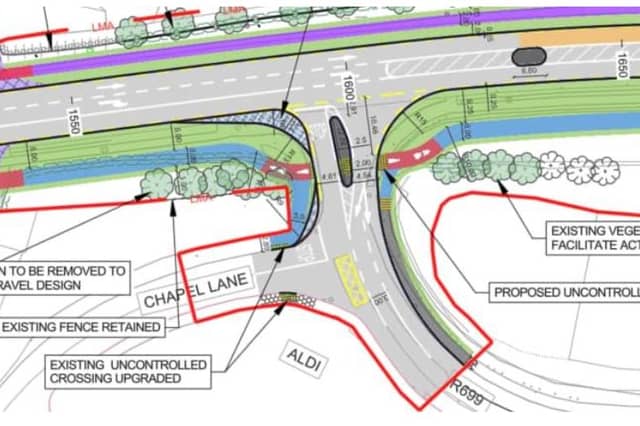

Details of a major plan to upgrade the Callan bypass have been revealed for the first time.
In a presentation from Transport Infrastructure Ireland (TII) to local councillors, long-awaited safety upgrade proposals took centre stage in the design.
Enhanced space for pedestrians and cyclists as well as safer, designated places for pedestrians to cross the N76 have all been included in the design.
It was warmly welcomed by the members of Callan Thomastown municipal district.
Game changer
Chairperson of the municipal district, Cllr Deirdre Cullen, said the council had been reiterating “we have to do something” about safety on the bypass as long as she had been elected.
She described the proposed plan as “incredible” and “an absolute game changer” for road safety and active travel in Callan.
She said the investment was long overdue but she was delighted the project is now progressing.
Among the features of the plan include a redesign of all junctions along the bypass, safer crossing points and tighter carriageways for traffic.
Adrian Morrissey, engineer with the TII’s design office, told councillors that the three main objectives of the plan are pavement maintenance and repair, road safety and active travel.
Currently, he said, the bypass sees vehicles travelling at "elevated speeds” which “directly increase the frequency and severity of junction conflicts.”
Wide carriageway widths also encourage high vehicular speeds and increase collision risks, Mr Morrissey said.
Current uncontrolled pedestrian crossings are substandard and compromise safety, the report went on, and highlighted that the N76 at Callan currently lacks dedicated provisions for active travel users for both pedestrians and cyclists.
“Structural surface degradation requires immediate renewal and repair works,” Mr Morrissey said.
The new design will stretch from the R698 Windgap junction with the N76 to the ‘Brett’s junction’ with the L1014.
A specific design has been drawn up for each junction along the bypass.
On the town side of the bypass the existing path will be replaced with a three metre shared space for pedestrians and cyclists. This will be separated from the roadway by a 2.5 metre grass strip and then a further half metre hard strip.
Existing designated pedestrian crossing points, like that at the ‘Aldi’ junction (West Street), will be moved slightly further away from the junctions. There will be dropped kerbs at the paths, ‘tactile’ paving and ‘refuge’ islands in the centre of the traffic lanes.
There will be similar arrangements for ‘gateway’ crossing points, which are located on stretches of roadway where there are not junctions.
Project Timeline
Mr Morrissey set out a timeline for the proposed project.
The Preliminary Design report has been approved by TII and the next step will be public consultation – which is now underway for a month.
It is hoped the project will go to tender in Q3 of this year and be awarded in the same quarter. Work could then begin in Q3 or Q4 this year.
The TII engineer said the project is estimated to take 15 to 18 months to complete.
Cllr Joe Lyons observed there was a lot in the plan that Callan had been “crying out for” for many years.
He queried if a path under the bypass from the Moate Field could be included as a safe way to cross the bypass, but was told the second phase of the Moate Field walking path has not progressed.
It was pointed out at the meeting that the bypass will also eventually see a reduced speed of 80kph, which is being brought in nationally for national secondary roads.
The public consultation arrangements will be advertised by Kilkenny County Council, in the Kilkenny People and online.
Copies of the plan can also be examined in several locations, including the Callan Area Office.