

‘Gives you a glimmer of hope’ - Long-lost species returns to Kilkenny
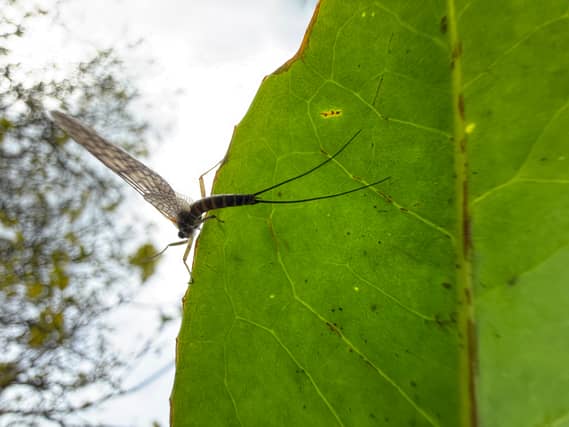

The flathead mayfly has come back to the Nore after last being sighted in the 1930s
As Fishery Manager and guide at Mount Juliet Estate, Dan O’Neill encounters diverse river wildlife on a daily basis.
However, a recent find was more notable than most as a long-lost species has returned to the Nore after over 90 years away.
The rare flathead mayfly hadn't been observed on the river since 1935 until it was unknowingly snapped in a photograph by O’Neill at Mount Juliet.
“I was just down by the river having a cup of coffee,” he recalls. “It was hammering down rain, typical Ireland, and along came this fly and landed on a leaf beside me.”
“I was looking at it for a second and thought it was a large dark olive which is a breed of mayfly,” he adds.
After writing a report for Inland Fisheries Ireland about the encounter, O’Neill was contacted by Dr Jan-Robert Baars from UCD’s School of Biology and Environmental Science who confirmed that the creature was indeed a more elusive kind of mayfly.
“There’s different things which he saw that I wouldn’t have a hope of seeing like veins in the wings, and he said ‘no, that’s a flathead mayfly,’” O’Neill outlines.
The chance encounter and the significance of elements of biodiversity returning are a source of positivity for O’Neill while other aspects of nature are struggling as multiple sightings of the mayfly have now been made.
“It’s nice to take a picture like that unknowingly and then someone contacts you who studies these things and says it’s a rare find. It gives you a glimmer of hope doesn’t it?”
The flathead mayfly’s presence is an indicator of good water quality and although this will surely be a promising find for O’Neill and others who work with rivers, he points to incidents like last year’s mass fish kill on the River Blackwater as a warning to avoid complacency and work to maintain any progress that is made.
“When we see something like that, it’s very important that we maintain it going forward because something very simple could wipe it out,” he says.
“Now that this has come back, it’s up to us to be extra vigilant when it comes to keeping water quality high,” he concludes.