

‘Cancer care has to come home’ - Health minister raises possibility of chemo services in Kilkenny during visit
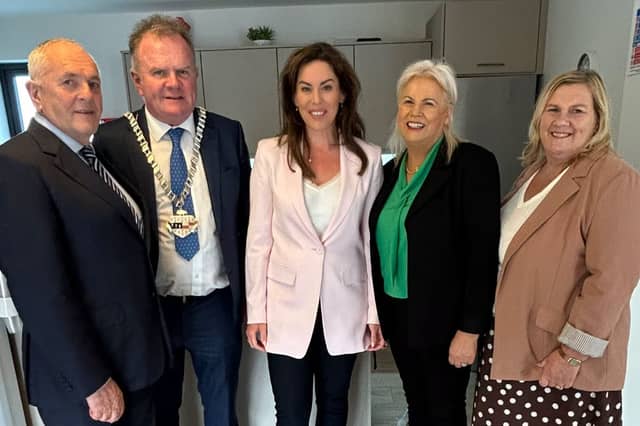

The Minister spoke about how 30% of chemotherapy services can be completed outside of acute settings
Minister for Health, Dr Jennifer Carroll MacNeill TD, outlined her desire to see some chemotherapy and cancer treatment performed in Kilkenny during her visit to the city this week.
The Minister was the special guest at the opening of Cois Nore’s newly completed cancer support centre, and took the speaking opportunity to describe plans to move some services to local centres where possible to reduce part of the burden on people going through treatment.
“Not all cancer treatment has to be delivered in Waterford. Not all cancer treatment has to be delivered in St Vincent’s,” she said. “We want to see what more we can do to deliver more appropriate cancer treatment in the community.”
“We know that about 30% of chemotherapy treatment can be delivered outside of an acute hospital and we can’t change that overnight, we can’t change it tomorrow. But one of the tasks for the NCCP (National Cancer Control Programme) and the HSE by me is ‘what more can we do next year’?”
“What can we build differently next year to hope that people might get some chemotherapy in Carlow or Kilkenny, in a primary care centre or in a facility other than a Model 4 hospital, more than we’re currently doing,” she added.
In the setting of hugely upgraded cancer support services for Kilkenny at Cois Nore House, the comments will have been cause for optimism that the momentum generated by the local charity’s years-long successful fundraising campaign might keep people at home as much as possible when dealing with the challenges of a cancer diagnosis.
“It’s happening in some places, it’s happening in some therapies, but what can be different for somebody living through cancer treatment at the end of 2027 than the beginning of 2027,” the Minister continued.
“What can we do to make sure that just one less person maybe has to get on a bus or in a car when they’re really not feeling well?”
“It’s possible for some of that treatment to come a little closer to home and that’s a big project for us next year. Cancer care has to come home.”
Minister Carroll MacNeill’s visit came the day after the Irish Nurses and Midwives Organisation (IMNO) voted almost unanimously in favour of industrial action due to cost-of-living pressure and lack of progress on a new public sector pay deal.
Despite 99.2% of the organisation voting for the action, the Minister believed that a deal would be done in time to avert any service disruptions.
“I work in partnership with the INMO and with all the unions to try and make sure that we have a balanced healthcare system and that we’re funding that in every way that’s appropriate,” she outlined.
“My colleague Jack Chambers is engaged with all of the unions in relation to the next public sector pay arrangement, and that’s for him to continue to do.”
“But certainly I’ve worked in great partnership with the INMO on all the different issues that have arisen so far in health while I’ve been minister and I thank them for the work that they’re doing up and down the country in Kilkenny and everywhere else at the moment.”
Despite the Minister’s confidence in the deal progressing, the healthcare system has endured a difficult summer with IMNO General Secretary Phil Ní Sheagdha saying that “morale was on the floor” after persistent overcrowding throughout the usually calmer period.
Minister Carroll MacNeill acknowledged the diversion from the norm in the figures and cited changing demographics and climate as some of the reasons behind the pressure on the system.
“It’s been very interesting and serious because the number of presentations has grown enormously. Emergency department presentations are up 7% this year right around the country,” she described.
“And at strange times, not just during the winter, but during the summer as well, we saw quite a large number of people particularly in August when it was very, very hot.”
“We had the winter’s flu problem and now we had a summer heat problem and that really does impact places like St Luke’s. We were waiting for a demographic explosion of older people. That is now here and we’re seeing that present in our emergency departments,” she highlighted.
One healthcare story that has continued throughout the year is the fight by people living with Friedreich’s ataxia to have the groundbreaking medication, Skylcarys, reimbursed in Ireland by the HSE.
That lengthy campaign ended in victory last month, but there is still no clear timeline as to when the medication will actually be received.
The Minister concluded by speaking about the logistical issues behind the delay and the work being done to procure Skyclarys for the Irish FA community.
“We have two issues. One, we have been working with the neurologist on where the medication would physically be delivered because you’ll appreciate some of these medications are not the kind of thing you put on the back of a truck and send to a pharmacy,” she said.
“They’re much more complicated and high-tech than that, so we’re working with the neurologist to work out where that will be done in the acute centres.”
“But the biggest problem that we have, which we’re working through with the company, is physically having the stock of the medication, so that is being worked on as we speak and I hope it will be resolved very soon.”
Article funded by the Local Democracy Reporting Scheme