

!No pasarán! - Kilkenny and the Spanish Civil War
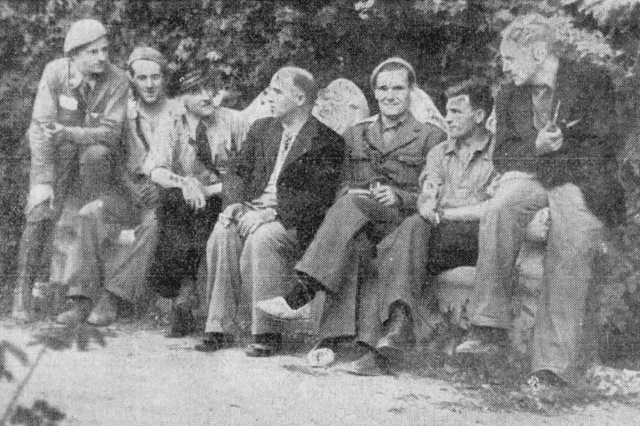

Ninety years on from the war’s outbreak, Cahal McAuley examines the impact and legacy of the Kilkenny men who served on both sides of the fateful conflict in the first of a two-part series
On a sweltering summer’s afternoon in the village of Villanueva de la Cañada, 30 kilometres northwest of Madrid, Inistioge’s George Brown lay wounded on the roadside.
Having huddled for cover from the fascist machine gun positions before advancing on Villanueva, scores of fighters from the XV International Brigade entered the village taking heavy losses in the process.
The objective was won and the wider offensive on the town of Brunete to relieve pressure on the capital was proceeding as planned.
But as his comrades attempted to reach him, Brown was summarily executed by a fascist soldier, and the life of Kilkenny’s most prominent combatant in Spain was snuffed out at just 30 years old.
Brown’s death, a bitter blow to his comrades in Spain and at home, was one of around half a million caused by the savage combat, devastating bombing, systemic executions and tragic starvation during the three year conflict in which far away Kilkenny would have its part to play.
Guerra Civil - The war begins
A truly unique war, Spain became a battleground for the world’s competing political ideologies while revolution and counter-revolution battled for dominance in a country which was to see its social fabric unravel beyond recognition in the midst of the fighting itself, and the decades to come.
Under the surface of the overarching struggle between democracy and fascism, a myriad of factions, motivations and consequences coalesced to create a war which would have ramifications far beyond its boundaries and served as a dress rehearsal of sorts for the largest conflict in human history, just months after the fall of the Republic.
Spain offered the first out and out opportunity for the world’s anti-fascists to take up arms against the movement which had already ensnared Hitler’s Germany and Mussolini’s Italy, a set of circumstances which galvanised opponents all over the world to join the International Brigades in defence of the Spanish Republic against General Franco’s nationalists.
Conversely, the anti-clerical acts of the Red Terror and persecution of priests and nuns along with burning of churches spurred Irish volunteers to take up arms for Franco in what many believed to be a holy crusade in defence of God and Catholicism.
These antithetical goals drew Kilkenny men from their homes to the battlefields of Jarama, Brunete and Lopera, with at least 10 local combatants taking part, including in leadership positions on both sides.
Despite the Brigades’ dedication and love for a country that was not their own, Spain ultimately fell to decades of a dark dictatorship under Franco, but even so, their sacrifices and legacies have not faded almost a century on.
La niña bonita - A republic is born
Democracy was an ideology on the defensive across Europe in the 1930s. Italy had seen Benito Mussolini, Il Duce, seize power in 1922 followed by Führer Adolf Hitler’s ascension to Chancellor of Germany in 1933.
Fascist movements in other countries were gaining ground on the political fringes, such as Oswald Mosley’s British Union of Fascists, which claimed a membership of 50,000 at its peak.
The Second Spanish Republic was established in the backdrop of these currents and found itself in various existential struggles from its inception.
Formed in 1931 after the bloodless deposition of King Alfonso XIII, the Republic, also known as the La niña bonita (the beautiful girl) in its early years, implemented liberal reforms like banning religious orders from the running of schools and the granting of home rule to Catalonia.
After maintaining control through a general strike and uprising in Asturias in 1934, elections in 1936 were won by the broad-left coalition Popular Front, an alliance containing communist, socialist and republican parties with support from regional nationalists and anarchist trade unions.
Though the left had managed to cling on to power and defeat the right-wing National Front opposition, much conservative and monarchist sentiment remained while anger fermented and plans for a coup d’état brewed among rebellious generals.
The uprising commenced on July 17, 1936 in Spanish Morocco, spreading to garrisons in the mainland over the following days.
However, the swift and easy path to a full transfer of power envisioned by the nationalists did not come to fruition in large part due to the arming of the workers in the Republic, an act which pushed back the rebellion in urban centres like Barcelona, Madrid and Valencia.
Not content with just defending the Republic, militias organised by groups like the anarchist CNT trade union and Marxist POUM party, saw the opportunity to launch their own revolution, collectivizing industries and agriculture, mostly in Catalonia and Aragon.
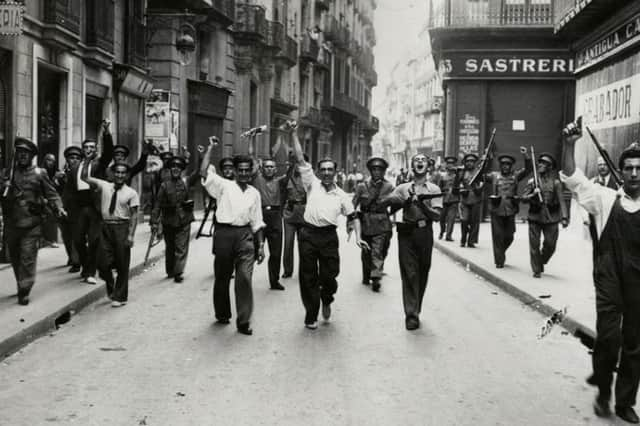
The coup had only been partially successful, Spain was split into nationalist and republican zones, revolution and counter-revolution had been launched, and the Spanish Civil War was underway.
The army had been split quite evenly between loyalists and rebels with both sides launching conscription and recruiting volunteers during the war’s opening months.
Though fought between Spaniards to begin with, the war and its ramifications for the future of Europe had captured international attention and eager recruits from across the world, Kilkenny men among them, were en route to make their own mark on the battlefield.
!Adelante! - The International Brigades arrive
Now immortalised in song and revered for answering the call to arms against fascism, the reality of how the Irish brigaders were viewed at the war’s outset couldn’t have been more starkly different.
Popular support lay mostly with the side of the nationalists, under the control of General Francisco Franco, owing to the belief that his was a mission of defending Catholicism against a ‘red horde’.
Stories of widespread murder of nuns and priests along with the burning of churches were exaggerated, but not false, and with the staunch Catholic nature of Ireland in that time and the church’s fiercely anti-communist position, volunteers for the brigades left Ireland quietly and often in secret with many who joined already being emigrants out of the country.
Orchestrated by the Communist International, the Brigades recruited some 35,000 volunteer anti-fascists (and more than 300 Irish), from over 50 nations to fight alongside the Spanish Republic, a force the likes of which had never before been assembled.
Four men from Kilkenny volunteered to fight in defence of the Republic and three served in the Brigades for varying lengths of time.
From the coal mines of Castlecomer were Michael Brennan and Sean Dowling. Brennan managed to successfully navigate the journey to Spain, but was sent home for being just 15 years old, his desire to take the fight to fascism not sated on that occasion, although his story wasn’t to end there.
Dowling arrived in the country in February 1937, where he would remain until the Brigades’ withdrawal at the end of 1938 with records indicating that he worked in several hospitals, something which suggests he may have been injured in battle early in the war.
Michael Brown, Inistioge-born and Manchester-raised, was among the first group of British-based volunteers to arrive, predating even the formation of the Brigades.
He became one of the first foreign combatants to get a taste of what was to come as his unit was brutally attacked by fascists at Lopera in December 1936. He returned home soon after.
It was Michael Brown’s brother, George, who was to leave the greatest legacy behind in Spain, and be the only Kilkenny man to give the ultimate sacrifice in defence of his convictions.
Born to Francis and Mary Brown in Ballyneale outside Inistioge on October 5, 1906, the couple had emigrated to Manchester but returned to Kilkenny for the births of their first four children, Michael and George included.
Though Manchester was home, George firmly kept in touch with his heritage, growing up in a house steeped in Irish culture and nationalism, also taking part in céilís in his city’s Irish clubs.
Brown was undoubtedly influenced by his Kilkenny and Irish roots, but his way of life in the English working class and labour movement shaped him just the same.
Having become involved in trade unions and taken part in the British General Strike of 1926, Brown joined the Communist Party of Great Britain and quickly rose through its ranks.
Organising workers during industrial disputes and utilising sharp debating skills, Brown made the most of his charisma and intelligence as friend and party comrade Mick Jenkins described years later.
“He had a quality which was a tremendous asset to a working class leader - the ability to state in simple everyday terms, the big issues of the day,” Jenkins said.
“He was able to explain Party policy to a street corner or a Trades Council meeting in language workers used and understood, drawing on everyday experience and happenings to illustrate the point he was making.”
His talent for leading class struggle saw him stand for the Communist Party in several elections in the mid-1930s, a period in which he also married his elections agent, Evelyn Mary Taylor.
Brown’s impressive rise in the trade union and political spheres of Manchester and Salford were not going unnoticed. The Kilkenny-born activist was elected to the party’s national executive committee in 1935.
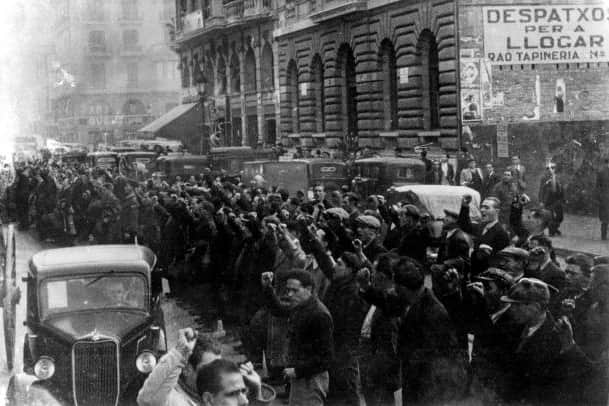
While some volunteers for the International Brigades were impressionable young men with a certain sense of naivety embarking in search of adventure, George Brown was a seasoned class organiser and a prominent communist with a national platform in Britain at the time he answered the call to defend Spain and reached the country in early January 1937.
Of course he wasn’t to know when disembarking from that fateful voyage, but he would not see his beloved Manchester or Kilkenny again.
La Bandera Irlandesa - O’Duffy’s men go forth
Scholars of wartime history will have observed, from Gettysburg to Mexico’s Battle of Monterrey, that often when Irish fighters join one side of a foreign conflict, they can be found on the other.
The Spanish Civil War was no exception, and though it is the anti-fascists of the International Brigades who are commemorated and celebrated in the modern day, a larger force, with greater support from contemporary Ireland also made their way to Spain in the war's early stages.
The fledgling Irish Free State found itself tightly in the influence of the Catholic Church, something which made the anti-clerical Red Terror and communist involvement in the Spanish Republic all the more abhorrent to the devout Irish population.
The revulsion felt towards communism by the church was exemplified in the Diocese of Ossory itself in the midst of activists attempting to form a union in the coal fields of Castlecomer in 1932.
Bishop Patrick Collier left no doubt as to his stance on the movement which may well have involved Sean Dowling, later of the International Brigade.
“I authoritatively say, ‘no Catholic can be a communist, no communist can be a Catholic’”, he thundered.
“We warn all obstinate leaders or agents of communism in this diocese that we will fight for our faith with all the tenacity and courage of our forefathers. And we will win. God is on our side. It is God’s battle.”
Reports of systematic murder of priests, almost 7,000, in the wake of the coup, and the desecration and destruction of churches horrified much of the Irish population who firmly opposed the ‘Godless reds’ of the Republic and saw General Franco’s nationalists as defenders of church and decency.
Enter Eoin O’Duffy. The former Fine Gael leader and organiser of the quasi-fascist Blueshirts and openly fascist Greenshirts who had been pushed out of public life saw his route back to relevance.
Capitalising on pro-Franco sentiment and accompanying sermons pontificated from the pulpit, O’Duffy was put in contact with nationalist forces and promised the rebels 7,000 volunteers.
In a rare break from the church, the de Valera government was aghast at attempts to draw young Irish volunteers into the conflict but could not stop 700 men, and at least seven of Kilkenny, from travelling to Spain in what they believed to be a solemn crusade in defence of God and faith.
Two-hundred men made their way in small groups followed by a larger force of 500, whisked away to Ferrol in Galicia by the German ship SS Urrundi which flew the Nazi swastika.
At O’Duffy’s right hand was one of his most loyal captains, Padraig Quinn from Graignamanagh.
Born around 1903, Quinn was the youngest survivor of the Coolbawn ambush and was an IRA and Free State Army veteran.
Like the vast majority of O’Duffy’s Brigade, or Bandera in Spanish, he joined the pro-treaty side in the Irish Civil War and later became an active Blueshirt organiser in Kilkenny.
The Glenmore History group details a Blueshirt sports day taking place in south Kilkenny in 1934, and with Quinn serving as director of the organisation’s local League of Youth wing, he is recorded as having made a speech at the event to its Carlow/Kilkenny chapter.
Professor Fearghal McGarry, author of Eoin O’Duffy: A Self-Made Hero, outlines how events like this and the work of Capt Quinn would have served to bolster Blueshirt numbers in Kilkenny and across the country.
“These people who had either been involved in the War of Independence or their families had, could put on the blue shirt and almost go back to the glory days of patriotism,” he said.
“In the areas where the Blueshirts were strong, there would have been a big social dimension. So there would have been dances and things, partly because it was quite boring in the Irish countryside in the 1930s.”
“So the Blueshirts would have given people something to do, not just the marches and the rallies, but a lot of social stuff as well. Just being able to organise in strength and show that you were dominant in a village and town was quite an attractive thing for young men,” Professor McGarry adds.
Though Quinn was undoubtedly an experienced officer and organiser, this most certainly cannot be said for his many of his fellow Irish Brigade members.
Rife with ill-discipline from the outset, the Bandera was garrisoned in the town of Cáceres where the unfamiliar availability of cheap, delectable wine was too much temptation for some brigaders to bear and drunkenness permeated the group.
Franco’s desire to send for an Irish Brigade in the first place had been driven by the need to appeal to the religious Carlist faction by recruiting a foreign force to defend their faith.
However, before the Irish had even arrived, Franco was sure of Carlist support and his requirement for the inexperienced unit for propaganda reasons had greatly diminished.
A hostile atmosphere grew as O’Duffy’s abrasiveness rankled with his Spanish superiors and the Brigade’s fortunes did not improve as they made their way to the front after their training had ended.
The Bandera’s most significant and valiant scrap, unfortunately for them, came against their own allies.
A group of falangist troops from the Canary Islands opened fire on the Irish, believing them to be part of the International Brigades due to the far fewer numbers of foreign troops on the nationalist side.
The Irish Brigade gave much better than they got, even if it was in friendly fire, as the skirmish left two of their men dead with at least nine casualties on the other side.
Losses to disease, artillery and general ill-health mounted as the Bandera manned the trenches at Ciempozuelos in the Jarama area, where the International Brigades fought close by.
Their only offensive action in Spain came in the form of a charge against the village of Titulacia in a heavy rainstorm.
Five were killed and 15 wounded before the Bandera retreated to their own lines, refusing to take up the fight again after sustaining losses which would have been considered extremely light in a war epitomised by near-suicidal frontal charges.
Morale had collapsed and patience for the Brigade’s incompetence and O’Duffy’s actions was wearing thin.
Less than affectionate nicknames such as O’Scruffy and Old John Bollocks became common among the Bandera’s ranks while General Juan Yague, who gained infamy as the Butcher of Bajadoz, did not hide his loathing of O’Duffy and lack of respect for the Irish fighters in a letter to Franco.
Yague wrote that due to “the total lack of professional commanders… the military effectiveness of this unit is absolutely nil” and urged for the Bandera to be withdrawn after their borderline mutiny at Titulacia.
O’Duffy offered to take his men home and Franco readily accepted. The debacle marked the end of the former as a political force and by the time of their return to Ireland, the Bandera did not receive the hero’s welcome they had expected.
By then, atrocities committed by the nationalists, such as the aerial destruction of Guernica by the German Condor Legion had become known, and the facade of Franco’s righteous crusade in defence of God was much more difficult to maintain.
O’Duffy attempted to save face by claiming he had always envisioned the Brigade holding a defensive role, something which Quinn said he resented while being interviewed for the 1976 RTE documentary, Even the Olives are Bleeding.
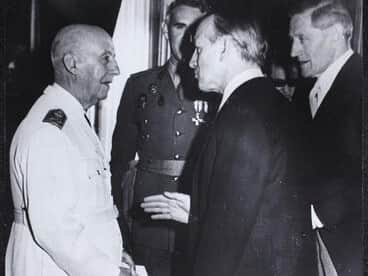
Despite the humiliation of O’Duffy’s forces, Quinn clearly remained proud of his decision to fight in Spain, and this was not forgotten by the victorious nationalists, as the Kilkenny man was met personally by Franco in Madrid in 1973.
Names recorded alongside him in the Bandera include James Morrissey and Patrick Smith from Thomastown, Cpl Dick Fluskey of Glenmore, Martin Kelly from Graignamanagh, William Green of Mullinavat and Cpl Michael Flanagan.
Though they set out with an Irish public largely in support of their crusade, due the horrors of Francoism and the later Second World War coupled with their own military disasters which saw about 15 men die, history does not look kindly on La Bandera Irlandesa.
The defenders of the Republic were keenly aware of the failures of their compatriots on nationalist side as George Brown himself detailed in a letter from Albacete just a month before his death.
“I see O’Duffy’s crew have gone back home leaving seven dead in the field of ‘honour’,” Brown wrote. “He complains a great deal about the wet trenches and his casualty list of rheumatic and pulmonary diseases.”
“It’s easy to see that the men he brought to Spain to fight for ‘religion’ hadn’t fought in their own country - for freedom and independence when they had a chance. The lads who fought on the hillsides for months on end didn’t complain that the hills and trenches weren’t aired.
“Maybe they discovered in Spain that the people who peddle religion are not generally the ones who practice it. Maybe Guernica helped them to make up their minds.”
“Well. Our Irishmen have been of different calibre. They have fought magnificently in the best traditions of the Irish struggles.”
To be continued...