

A walk through Fossil City, Kilkenny - where 300 million-year-old creatures permeate our paths and buildings

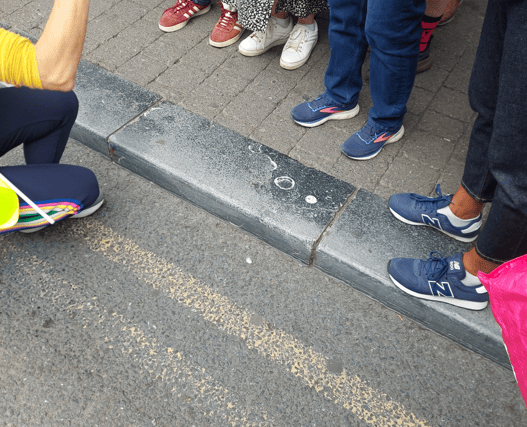

A well-attended fossil walk took place in Kilkenny as part of Heritage Week
We walk past them — and, indeed, on them — all the time when we navigate the streets of Kilkenny, but few people pay them any attention or even notice their existence.
Fossils dating back hundreds of millions of years are present throughout much of the famous ‘Kilkenny Marble’ — the darkened limestone that is abundant in use all across the built environment. Kilkenny derives its moniker, ‘The Marble City’, from this sedimentary stone, but it could just as well have been called ‘Fossil City’. Because when you start to notice these markings, and look for them, you will see them everywhere.
Maria McNamara, Professor of Palaeontology at the School of Biological, Earth and Environmental Sciences at University College Cork, was our guide for a full capacity fossil walk as part of Heritage Week.
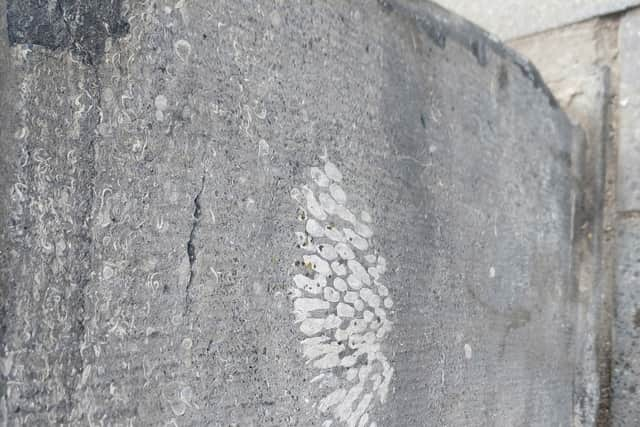
Coral fossil in the limestone
At the time, Ireland was a very different place. For a start, it was underwater —beneath a shallow, warm and tropical sea. It was also in the southern hemisphere, the tectonic plates yet to shift it north to its present geographical location.
Known as the ‘Carboniferous Period’, it lasted from about 359.2 to 299 million years ago during the late Paleozoic Era.
The white semi-closed shapes are fossils of brachiopods, small ‘valve’ creatures that latch on to the seabed. With 97% of their body mass comprising shell, brachiopods have no natural predators, and still exist today in our oceans.
To the left of that is an example of ‘colonial coral’, while on the next kerbstone is an unmistakenably spiral-shaped fossil. It belongs to a gastropod — basically a sea snail, which suggests a number of things about the seafloor where it would have settled.
Our tour also takes us to the gates of Kilkenny Castle, where some of the limestone used in that great arch are riddled with thousands of brachiopod, gastropod, and coral fossils. We also see examples of tabulet coral and solitary coral. It’s symbiotic algae would have been phototropic, so we can tell which direction it was growing, and whether the stone is ‘upside down’, and whether it is cut through in cross-section, or top down.
Within the Castle Park, we see newer fossils, from when the Carboniferous era came to an end. The ocean as it had existed was destroyed, the Caledonian mountains — an ancient range stretching from North America across Ireland to all the way to Scandinavia — rose up from the sea. As they eroded, the shed silt and sand, creating deltas 325 million years ago. No more tropical Ireland.
We now see wiggly lines in the flagstones —the tunnels and tracks of small creatures burrowing their way around. They were not worms, as apparently worms do not do 180-degree turns, and we can see many of these in the stone. They are the only fossils in these rocks, which indicates low biodiversity in the area at the time, probably due to the delta’s mix of freshwater and saltwater, which is inhospitable to many aquatic species.
At Rive Gauche and the Left Bank, we see more examples of colonial corals, like honeycombs, permeating through the fabric of the building. We finished up on High Street after a very enjoyable hour and a half — so thank you to Professor McNamara for her time and patience.