

Good Shepherd Centre Kilkenny CEO on homelessness and housing
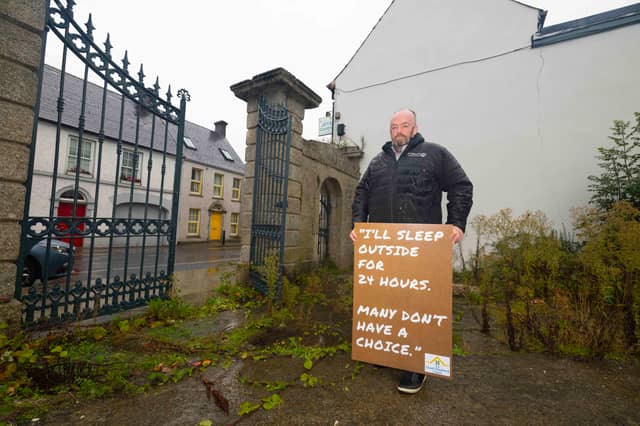

Noel Sherry - ‘There is more money going into funding homeless services than there ever was, and there’s certainly more housing, but the demand is killing us.’
“The victim of our success is homelessness and poverty. It’s nothing to celebrate,” says Noel Sherry, CEO of the Good Shepherd Centre Kilkenny (“GSCK”), a charity providing services to people in Kilkenny experiencing or at risk of homelessness. While the GSCK originated in Kilkenny, its work now spans eight counties.
“We’ve now gone from having nine units to 467 tenancies around eight counties,” says Sherry. “Last winter, we operated two hostels and four cold weather initiatives, which are temporary pop-up hostels. That’s increasing all the time because numbers are increasing.” Mr Sherry estimates that there are currently 47 people homeless in Kilkenny. He highlights the achievement of the “Own Front Door” programme, which, as the name suggests, provides community-based emergency accommodation as an alternative to hotels or hostels. There are currently 42 “Own Front Door” placements in Kilkenny. Sherry says: “There is more money going into funding homeless services than there ever was, and there’s certainly more housing, but the demand is killing us.”
Since Mr Sherry began working at the GSCK in 2017, the profile of service users has changed. He has noticed an increase in people with autism attending the centre, as well as people with “dual diagnoses” – sufferers of both addiction and mental health issues, who are refused by psychiatric services. But the main development is a proliferation of people presenting purely due to housing difficulties. “We’ve seen an increase in people coming in working, and their only flaw is that they’re being evicted, and they can’t find somewhere to rent because the private rented market in Kilkenny is in a state of collapse and is continuing to disimprove,” says Mr Sherry. “We’re seeing many more families. They’re ordinary people who private rented accommodation has failed.”
The GSCK hostel received 372 referrals in 2025, up from 241 in 2024, and processed 149 admissions, up from 94 in 2024. The centre is currently six people over capacity. Sherry says: “We’re one single hostel covering a county, and there’s no way of managing threshold. In some situations you need high-threshold services, and in others, you need low-threshold services, and we have to do both.” He continues: “We’re not seeing children rough sleep yet, but I would say if things keep going the way they’re going, we will see children being forced to rough sleep.”
The GSCK is in daily contact with the Kilkenny County Council Housing Department to coordinate placements. Mr Sherry says: “I don’t think people realise just how busy the local authority in Kilkenny is. They could have as many as 50 to 70 ‘Notices to Quit’ on their desk at any time – mainly families who they are working very hard to find solutions for.”
Asked what the public can do to mitigate homelessness, Mr Sherry says: “stop giving people money, because you’re either giving organised crime that money, or you’re just helping someone feed a very dangerous habit.” Sherry warns against conflating homelessness with begging, which is “an issue in its own right” but is “not immersed in homelessness.”
Mr Sherry explains that: “sometimes, there are people who are genuinely homeless sleeping on Kieran’s Street.” In the case of such individuals, Mr Sherry and his colleagues “actively engage them and try to draw them towards the centre.” He adds, however, that: “sometimes, there are people begging who are part of an organised crime group, and who are from outside Kilkenny.” He continues: “We were tracking these particular people from Romania who were moving between four prominent towns. [...] We were offering them homeless services during bad, adverse weather. [They were] point blank refusing to come in.” Sherry instead advises: “You can help by doing an own jumper day in school. Raise a few pounds for your favourite charity; it doesn’t have to be us.”
“By the way, little miracles do happen,” he says.
At Christmas, he receives messages from people who have passed through the GSCK.
“[From] most of them, it’s good news. One woman I worked with has three adult children now. One of them is a junior barrister, another is a doctor and the other is a doctor of biology,” says Mr Sherry. “They only make it because, at a period of time when they’re at their lowest, they get that support.”