

‘Insidious shift’: Kilkenny Senator calls for answers on Government’s human rights position

The European Convention on Human Rights was signed by Ireland in 1950
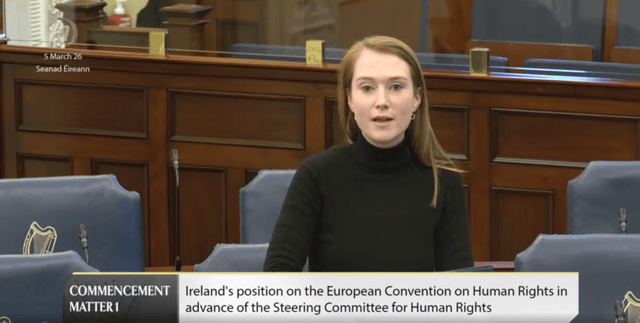
Kilkenny-based Senator, Patricia Stephenson (SD), criticised the Government’s signalling of support for a revision of the European Convention on Human Rights (ECHR) and called for clarity on the reasons behind its position in the Seanad on Thursday.
The possible shift in policy was triggered by a joint statement signed by 26 of 46 Council of Europe justice ministers, including Jim O’Callaghan TD (FF), pushing for alterations to the Convention to curb migration challenges.
The statement urges a re-examination of Articles 3 and 8, which detail protections from torture and inhumane or degrading treatment and guard the right to respect for private and family life respectively, as they have come under criticism for acting as a barrier against the deportation of illegal migrants.
Opponents to the changes have argued that they could lead to a weakening of the protection of human rights across the EU while Senator Stephenson referred to the statement as a “quiet but insidious shift in Irish policy.”
Addressing Minister of State at the Department of Culture, Communications and Sport, Charlie McConalogue TD (FF), the Senator questioned the nature of the “deeply concerning and perplexing” u-turn along with what she considered to be insufficient public consultation.
“This would weaken our standards on torture and inhumane and degrading treatment,” she said. “The whole process around the political decision to support amending elements of the ECHR was done without any meaningful public debate,” she added.
Critics have also pointed out that weakening the Convention could have implications for the Good Friday Agreement with Ireland itself bringing the first ever inter-state case against the UK in relation to the conduct of British soldiers and treatment of those interned.
The Court ruled in 1978 that Article 3 breaches of inhumane and degrading treatment had occurred with Ireland also launching a case against the Troubles ‘Legacy Act’ bill in 2023.
Minister McConalogue replied that the changes were being sought “in the context of contemporary challenges posed by both irregular migration and by the situation of foreigners convicted of serious offences, taking duly into account governments’ fundamental responsibility to ensure national security and public safety.”
Senator Stephenson went on to question the truth behind the claim that the Convention was a reason behind deportations being prevented as no data is available for this while also highlighting the fact that countries like France, Germany, Spain and Turkey, which take in a disproportionate amount of migrants, did not sign the statement.
Concluding, the Senator once again called for the protection of human rights agreements in the midst of uncertain times and huge pressure for international law.
“We are living through utterly terrifying times in terms of global norms being ripped up. During times of turbulence and polarisation, we need to be holding on to the legal frameworks which underpin our self-proclaimed values of human rights and dignity.”
The Steering Committee for Human Rights of the Council of Europe will meet to discuss the Convention next week while a declaration in favour of the alterations is expected to be adopted at the next formal session of the Committee of Ministers in Chisinau, Moldova in May.
Article funded by the Local Democracy Reporting Scheme