

Kilkenny's 'armchair archaeologist' makes amazing 6,000 year old discovery!

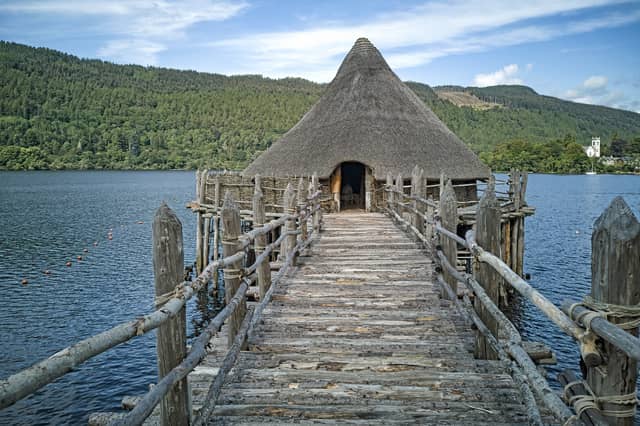

Artificial island homesteads dating from the New Stone Age have been discovered by an 'armchair archaeologist' - from her armchair in Kilkenny!
The three previously unknown crannogs were discovered this month in Co. Cavan by volunteer OpenStreetMap contributor Anne-Karoline Distel.
Crannogs date from 6,000 to 4,000 years ago! They are artificial islands constructed from the Neolithic (or New Stone Age from c. 4000 to c. 2,500 BCE) and inhabited until the late Middle Ages. They are mostly found in Ireland with some examples in Scotland and one known example in Wales. Kilkenny's only known crannog is to be found in the townland of Loughmerans, just north of the city.
Anne is passionate about Irish heritage and mapping - interests that have brought her to these, and other discoveries. While studying maps of several lakes in Co. Cavan she was overjoyed to discover several suspiciously circular features. Checking against older Ordnance Survey maps and the Sites and Monuments records on https://maps.archaeology.ie/HistoricEnvironment/, she established that they were not yet recorded. Anne reported 12 possible crannogs to the National Monuments Service and had three confirmed by Aislinn Farrell from the National Monuments Service a few days later. They are to be found in Parisee Lough (54.09546,-7.38870), Kilconny Lough (54.10964,-7.45079) and Mill Lough in Drumconlester (54.00165,-7.51843).
OpenStreetMap is an OpenSource and OpenData map which works like Wikipedia in that anyone can edit it. It serves as a map service for many national and international companies like Facebook, daft.ie, Met Éireann, Transport for Ireland and many more. Anne was working on OpenStreetMap Ireland's project to add all buildings to Ireland's map using satellite imagery. She focused on the lakes of Co. Cavan, because she was hoping to find undiscovered crannogs.
Anne finds it fascinating to imagine a life on a crannog with its round huts and thatched roofs which is so far removed from the way people live today. Several crannogs have been re-created in Ireland and the UK in heritage parks open to visitors like the National Heritage Park in Wexford, Craggaunowen in Co. Clare or the Scottish Crannog Centre (which has to rebuild its crannog after a fire in 2021).
Anne, who hails from Germany and is based in Kilkenny, has no formal training as a GIS professional or archaeologist, had discovered two previously unrecorded enclosures in Co. Tipperary in May 2022 which have also made their way into the Sites and Monuments Records.