

Kilkenny to the fore as Rás na mBan unveils landmark 20th anniversary route
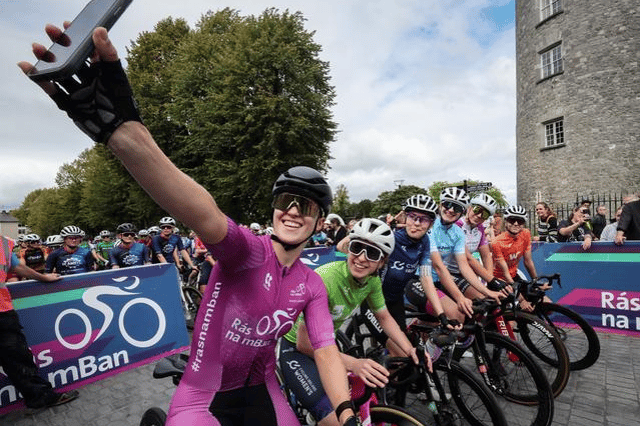

There may be three new stages and two new locations, but Kilkenny is still number one when it comes to the Rás na mBan.
Ireland’s premier international women’s stage race returns to the Marble City for its 20th anniversary edition this Septemner, offering a return to the race’s historic roots and the most ambitious route redesign for years.
To mark their landmark year, the organisers of Ireland’s top international stage race have produced a route with three all-new stages, two new race locations and other innovations in the most radical overhaul in years.
Now in its 10th year in Kilkenny, where the five-day, six-stage event will both begin and conclude again this year in the first week of September, this year is also the 40th anniversary of the John Hearn Memorial Stage Race, Ireland’s first international multi-day road race for women and an event to which Rás na mBan can trace a direct lineage.
To celebrate that milestone, stage three of this year’s race returns to Carrick-on-Suir for a brand new stage with a start and finish within metres of that momentous launching pad in 1986.
In a first for the event, there is an all-new stage almost entirely in County Carlow with a first summit finish for several years on Mount Leinster’s daunting Corrabut Gap climb.
County Wexford hosts Rás na mBan for the third time, with a brand-new festival of racing centred on the popular tourist destination of Gorey. Featuring both the start and finish in the town, the stage promises to be one of the toughest of the week.
One aspect of the race which remains untouched is the hugely popular final day double helping of racing action with a short time trial at Kilkenny Castle followed by the race’s fastest stage at the same location, the one-hour circuit race where the race will conclude after five days and over 400km of top level international road racing action.
Stage One: Riders will again depart from Kilkenny on Wednesday, September 2, heading north on day one, passing through Freshford before riding towards Urlingford for the first intermediate sprint of the week and crossing the county lines into Tipperary shortly afterwards.
For this year’s opening stage there will be an extra 200m in elevation over an additional 22km. Riders will take on 856m of climbing across 98km. While the route will mirror last year in the opening 76km, riders will pass through the finish line in Freshford and continue for 8km on the original route before taking a sharp left and heading for the top of Rathealy from a different angle before a fast finish in Freshford.
The extended 2026 version will feature three Queen of the Mountains (QoM) opportunities, for any climbers hoping to make their mark early in the race. Kearney’s Hill will play host to the opening battle for the coveted IVCA Wicklow 200 QoM jersey, while Rathealy will provide additional challenge with maximum gradients of 13.5% (average of 3.1%) on the second ascent.
Stage Two: On stage two Rás na mBan returns to Wexford for a third consecutive edition. This year the riders will set out from Gorey along the Arklow Road.
After crossing into County Wicklow, riders will turn west from Arklow towards Aughrim, taking on the intermediate sprint at Woodenbridge along the way towards the first climb of the day.
Annacurra will feature the first QoM opportunity of the day, before an undulating ride south through Carnew to Sliabh Buí.
From there riders will be able to enjoy some downhill towards Ferns, before the course turns east again and begins to drag again until close to Ballycanew. Heading north from there, a fast finish is expected in Gorey town after 97km of racing and 1,139m of climbing.
Stage Three: Stage three takes riders to Carrick-on-Suir, for another looped route. Leaving Carrick, they will race towards a short sharp climb on route to Ninemilehouse, before a short sharp descent as they turn towards Mullinahone. From there the road drags towards Knockabritta as they race towards Killenaule.
The road towards the intermediate sprint at Fethard is expected to be fast with plenty of downhill continuing as they race towards Clonmel. Riders will then face one of the most challenging climbs of this year’s edition of the race as they enter onto the Tickincor QoM, 3km long with an average gradient of 7.9%. Having passed into County Waterford, the following 20km will again feature plenty of downhill before taking on the much shorter, but steeper, Seskin QoM followed by a downhill finish back into Carrick-on-Suir after 102.5km of racing over 1,127m.
Stage Four: Stage four is the final new addition to this year’s Rás na mBan, as the race turns to Carlow. The stage features a largely flat opening 55km, with intermediate sprint opportunities at Bagnelstown and Garyhill. From there, the riders will be tasked with Corrabut Gap QoM, far from the longest climb in the week’s racing but definitely the steepest with an average gradient of 11.5% over the 1.5km.
A welcome descent to Bunclody follows, however riders will have to turn east again at Kildavin towards Myshall, and rejoin the previous route to complete a second summit of the Corrabut Gap for a hilltop finish after 88.5km of racing and 1,074m of elevation.
Stages Five and Six: Kilkenny City will again play host to the final day of racing, with two stages centring on the imposing edifice of Kilkenny Castle. Riders will reprise the recent tradition of the 2.5km time trial around the walls of the castle as the specialists against the watch have an opportunity to offset the advantage enjoyed by the climbers on previous stages.
The final stage of the week remains the hugely popular circuit race in Kilkenny City Centre, the fastest stage of the week. Stage six is 75 minutes of high octane city centre racing, after which the champion of Rás na mBan 2026 will be crowned.