

EXCLUSIVE: Risk of potential ‘harm’ to Kilkenny patients revealed



Records released by the Health Service Executive to Kilkenny Live under Freedom of Information legislation identifies delayed 999 response times as an open operational risk
An internal National Ambulance Service (NAS) risk register obtained by Kilkenny Live has warned that staffing capacity and increasing demand could lead to delayed 999 response times, compromised patient care and regulatory non-compliance.
Newly released documentation also showed that fewer than half of Kilkenny’s highest-priority calls received a response within the relevant timeframe in May.
The records, released by the Health Service Executive to Kilkenny Live under Freedom of Information legislation, identifies delayed 999 response times as an open operational risk.
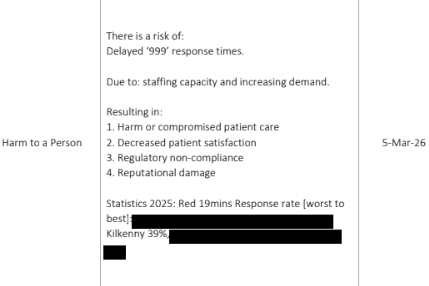
It says the potential consequences to this risk include harm or compromised patient care, decreased patient satisfaction, regulatory non-compliance and reputational damage.
The risk was entered on March 5, 2026. The released copy carried an April 30 review date and continued to list the risk as open.
Existing controls recorded by the NAS included regular assessments of staffing needs, flexible staffing models, resource allocation, recruitment initiatives and monitoring of performance against key indicators.
Other measures included alternative care pathways such as Community Paramedicine and Pathfinder, the use of Community First Responders and continued monitoring of staffing levels, absences and workload patterns.
MONTHLY FIGURES
Monthly data released with the decision show the practical context for the risk.
In May 2026, 43% of red calls in Kilkenny received a response in under 19 minutes. Red is one of the two highest dispatch-priority categories used in the figures.
The released tables also show that 60% of purple calls received a response in under 19 minutes that month.
Taken together, fewer than half of the purple and red incidents recorded in Kilkenny during May met that timeframe.
In the same month, 19% of red calls took more than 49 minutes to receive a response. This was the highest proportion since September 2025, when the figure was 20%.
The monthly percentages should be treated with some caution, particularly for purple calls, because the number of incidents can be small. There were 10 responded-to purple incidents in Kilkenny in May, compared with 326 red incidents.
RESPONSE TIMES
Across all emergency categories, Kilkenny recorded 678 responded-to incidents in May 2026.
The median response time was 25 minutes and 37 seconds, while the average was 41 minutes and 48 seconds. The 90th-percentile response time was one hour, 27 minutes and 20 seconds, meaning approximately one in ten responded-to incidents took longer.
Those measurements combine every acuity level and should not be read as response times for critical calls alone.
They also cover incidents that received a response, rather than every emergency call received by the service.
The HSE said it could not provide the number of cases in which no ambulance was immediately available because its system does not record that information in the form requested.
Instead, its available data record the elapsed time between completion of call triage and the allocation of a resource.
The NAS also said it does not hold a record or data field identifying an incident as having been delayed specifically because of resource constraints.
That portion of the request was refused under section 15(1)(a) of the Freedom of Information Act, which applies where a requested record does not exist or cannot be found after reasonable searches.
OVERALL DEMAND
The released figures show that demand in Kilkenny has increased.
The acuity tables record 6,513 responded-to incidents in 2022, rising to 6,809 in 2023, 7,384 in 2024 and 7,951 in 2025.
That represents an increase of approximately 22% between 2022 and 2025.
A further 3,409 incidents were recorded during the first five months of 2026. That was 5.8% more than the 3,221 incidents recorded during the corresponding period of 2025.
The figures also show an improvement from the most severe delays in the series.
In December 2022, the average response time across all acuities was one hour, 19 minutes and 32 seconds, while the median was 41 minutes and nine seconds.
The 90th-percentile response time that month reached two hours, 49 minutes and 57 seconds.
By comparison, median response times during the first five months of 2026 ranged from 23 minutes and 24 seconds to 25 minutes and 37 seconds.
COMMENT FROM NAS
In its FOI decision, the NAS cautioned against treating response-time targets as a complete measure of the quality or effectiveness of patient care.
It said there was established clinical justification for speed in cases of cardiac or respiratory arrest, but argued that there was little or no equivalent clinical evidence underpinning time-based targets for other ambulance incidents.
The service said clinical-outcome indicators, which focus on the effect of care on patients, provide a more meaningful assessment.
Response-time data nevertheless remain part of the performance information recorded and released by the service.
The NAS also placed the Kilkenny figures within a wider national capacity problem.
The service said its whole-time-equivalent staffing limit stood at 2,657 at the end of 2025, representing an increase of 528 since 2019.
It said the HSE’s 2026 service plan provides for additional ambulance-service resources as part of planned new developments.
However, the NAS warned that several years of sustained and consistent investment would be required to reduce what it described as a widening gap between rapidly increasing demand and the capacity available to respond.
The records therefore present a more complex picture than any single response-time measure can capture.
Kilkenny’s typical response times have improved markedly since the exceptional delays recorded in December 2022, while staffing has increased nationally and alternative models of care are being developed.
At the same time, local demand is rising and a notable minority of serious calls continue to involve substantially longer waits.