

Richard Cook: Eamonn Langton had an extraordinary ability to see what Kilkenny could become
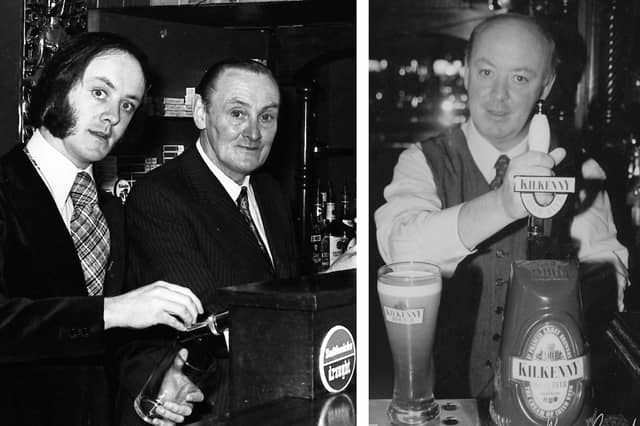

Talent agent and festival mogul Richard Cook shares what he learned from a great businessman and publican Eamonn Langton, who died last week
It is easy now to look at Langton’s on John Street and imagine that it was somehow always there. The hotel, the restaurants, the ballroom, the bars and everything around them have become so much a part of Kilkenny that it is difficult to remember that most of it began with one man looking at a family pub and imagining something much bigger.
Eamonn Langton had an extraordinary ability to see what Kilkenny could become.
I half knew Eamonn for more than 30 years. I don’t think I ever really knew him, but then I never particularly tried to. Ours wasn’t that kind of relationship. And yet, when I look back over my professional life, I don’t think anyone has influenced or inspired me more.
He could be difficult. He could be demanding. He was certainly bloody-minded and stubborn. He had high standards and very definite ideas about how things should be done. But he was also one of the most generous and instinctively supportive people I have encountered, particularly when somebody was trying to make something happen.
In my case, that started long before The Cat Laughs. In 1992, Lynn Cahill and I were part of Bickerstaffe Theatre Company and putting on a production in the back of Cleere’s. I managed to get a short meeting with Eamonn, explained what we were trying to do and asked him if he’d take a half-page ad in the programme.
“How much?”
“£50.”
He paused for a moment, stood up from his chair, pulled a cheque book from his pocket and wrote me a cheque for £50.
“Don’t spend it all at once.”
And he was gone. It sounds like a tiny thing now. It wasn’t to us.
And I think that small exchange illustrates something quite fundamental about Eamonn. He listened, made up his mind and did something. He wasn’t someone who needed to wait and see whether an idea worked, whether an audience turned up or whether everybody else had decided it was worth backing.
Eamonn wasn’t a wait-and-see man.
When Lynn and I kicked off The Cat Laughs in 1995, there was absolutely no reason for anyone to believe that a comedy festival in Kilkenny was going to work. In truth, we were making it up as we went along and trying to persuade other people to share our slightly unreasonable confidence that if we brought great comedians to Kilkenny, audiences would come.
But Eamonn backed us and helped fund the very first festival. Later, when The Cat Laughs made the difficult transition from Guinness to Murphy’s, Eamonn backed us again, even though it risked compromising his own business relationship with Guinness.
“There’ll be trouble ahead,” he said to me, with that slightly mischievous laugh of his.
He was right, of course. There was plenty of it. But I always sought Eamonn’s approval, probably more than he realised. His opinion mattered to me because he understood what it was to take a chance on something — and, perhaps more importantly, I knew he had my back.
When things got noisy, he would sidle up to me with that familiar glint in his eye.
“Don’t worry about that.” Or: “Don’t mind them. Keep going.”
I think he saw something in me then that he recognised: a young disrupter, perhaps, more interested in making something happen than in asking everybody’s permission to make it happen. Eamonn understood that instinct because it seems to me that he had spent much of his own life doing exactly that.
Much later came Kilkenomics and Subtitle, very different festivals with very different audiences, and Eamonn and Langton’s were woven through all of them — venues, rooms, encouragement and, very often, solutions to problems we hadn’t quite worked out ourselves.
I think what I learned from Eamonn over those years was: don’t spend too long talking about what you might do. Do it. Show people. Create the thing. That was much more Eamonn’s way.
His own ideas weren’t always universally welcomed and he could push things further and faster than other people were comfortable with. He wasn’t always right. Nobody with that appetite for changing things could be. But he was prepared to do things and live with the consequences. He knew that if you waited until everybody agreed with you, you might wait forever.
What Eamonn did with Langton’s was really the same instinct on a much bigger scale. He never seemed to regard what was already there as the limit of what it could become. He kept adding, changing, building and imagining.
And the scale of what he built is less interesting to me than the thinking behind it. Eamonn understood something about hospitality long before people began using words like ’experience’ to describe it. It wasn’t simply about selling somebody a pint, a meal or a bedroom. It was about creating places where people wanted to be.
His antennae were always pointed outwards. He was interested in what was happening in London, New York and elsewhere, and you could see those influences finding their way back to Kilkenny. He never seemed to accept the proposition that something should be merely ’good enough for Kilkenny’.
But he wasn’t trying to turn Kilkenny into somewhere else. He had a remarkable instinct for the city and the people in it. He simply didn’t believe that living in a relatively small Irish city meant your standards or imagination had to be smaller.
He had a world view and the common touch. That is a very rare combination and, I think, what made him special.
I’m not sure that Eamonn’s influence on Kilkenny’s reputation is always fully appreciated. His standards made other people raise theirs. More importantly, he helped change what people expected to find in Kilkenny — and what people outside Kilkenny came here expecting to find.
He was only one part of the transformation of the city, of course, but I think he helped drive it. Kilkenny’s reputation today for hospitality, festivals, food and as a place people actively choose to spend a weekend owes more to Eamonn than perhaps we acknowledge.
And for somebody who had that kind of influence on his city, he didn’t seem particularly interested in explaining himself. There aren’t endless interviews with Eamonn or speeches setting out his vision for Kilkenny. He was much more interested in doing things than talking about doing them. And I love that.
The Set Theatre is a good example of how that instinct continued into another generation. Created by Conor and Eddie and designed by the brilliant Dublin-born, London-based designer David Collins, it is an extraordinary thing to find in the middle of a hospitality business in a small Irish city, and yet somehow it feels completely at home there.
It is Conor and Eddie’s achievement, but I think it also says something about the world Eamonn had created around them. By then, the idea that Langton’s might contain a genuinely beautiful purpose-built theatre didn’t seem absurd. The boundaries of what the place could be had already been stretched so many times.
Langton’s was also where I got married in 1997. There were 500 people there and, as I remember it, the free bar never stopped. I’m not entirely sure how we afforded it. Knowing Eamonn, I’m not entirely sure we did.
People of a certain generation will remember a different Langton’s — wild nights, packed clubs, dancing until all hours and weekends that occasionally took a little while to recover from. These days weddings are a huge part of the life of Langton’s.
But perhaps the places Eamonn built have adapted so well because he built them, above all, for people to enjoy themselves. The reasons people gather there may have changed, but that hasn’t. And there is something wonderfully fitting about so many people still having one of the greatest nights of their lives in the places he built.
When Eamonn was awarded the Freedom of Kilkenny earlier this year, it felt as though formal recognition had come relatively late. He had already stepped back from the business, but perhaps there was something appropriate about that: the city finally had a chance to acknowledge what he had already done.
I don’t think Eamonn ever set out to teach me anything. But more than 30 years later, I realise that I learned an enormous amount from him.
Don’t wait for everybody to agree. Don’t spend too long talking about what you might do. Do it.
And a voice in my head: “Don’t worry about that. Don’t mind them. Keep going.”