Search


30 Mar 2026
Search
30 Mar 2026

Please allow ads as they help fund our trusted local news content.
Kindly add us to your ad blocker whitelist.
If you want further access to Ireland's best local journalism, consider contributing and/or subscribing to our free daily Newsletter .
Support our mission and join our community now.
To continue reading this article, you can subscribe for as little as €0.50 per week which will also give you access to all of our premium content and archived articles!
Alternatively, you can pay €0.50 per article, capped at €1 per day.
Thank you for supporting Ireland's best local journalism!

Francis Place 1699 view of Kilkenny Castle

Most of us in Kilkenny will have spent many a sunny day on the grounds of the Castle Park at Dukesmeadows; but few will have been aware of the possible presence of a lost medieval village beneath the soil.
New light may well be shed on the centuries-old mystery however, as a search is taking place this week for the village of Flemingstown, a purpose-built settlement in the castle’s outer wards which was home to an immigrant community of artisans from what is now modern-day Belgium.
The settlement was built by the Archduke of Pembroke, William Marshall, in the early thirteenth century, to house skilled Flemish industrialists, brewers and textile workers with a notable family originally from the region being the Kytelers, but the precise location of where the remains of Flemingstown lie has long been forgotten.
“There’s always been a bit of a mystery about exactly where the town was,” says Cóilín Ó Drisceoil, Archaeologist with the National Monument Service who’s been involved in years’ worth of research on Kilkenny heritage.
“It was abandoned partly in the 15th century, there were some scant remains of it around in the 17th century and then the whole place was lost; it just disappeared. It was never mapped or anything so we’ve been searching for it for many years,” he adds.
READ NEXT: All-Ireland glory for Kilkenny handballers on action packed day in Kilfane - Kilkenny Live
The current survey of the grounds is being conducted with the national archaeological research institute, the Discovery Programme in conjunction with the National Monument Service and OPW in Kilkenny Castle with funding from the Castle Studies Trust, a UK-based castle research organisation.
The research consists of a geographical study which maps the underground terrain using state of the art technology and preliminary scans came through on Wednesday afternoon.
Although the results gathered so far still need further investigation in order to be confirmed, Cóilín is confident that the ancient settlement of Flemingstown is about to finally be located.
“We’ve got absolutely fantastic results,” he outlines. “We can clearly see the main street of Flemingstown. We can see the houses and the wall that ran around and now we’re able to map in considerable detail exactly where it is precisely.”
If subsequent data analysis confirms these suspicions that the structures located are indeed the remains of Flemingstown, the significance of the discovery will be unlike anything else in the country.
“This is a unique example of a purpose-built settlement for a medieval castle in Ireland,” Cóilín explains.
“There’s nothing like this. There’s no other towns that were purpose-built for Flemish artisans and the like in Ireland, so it’s unique in that sense,” he concludes.
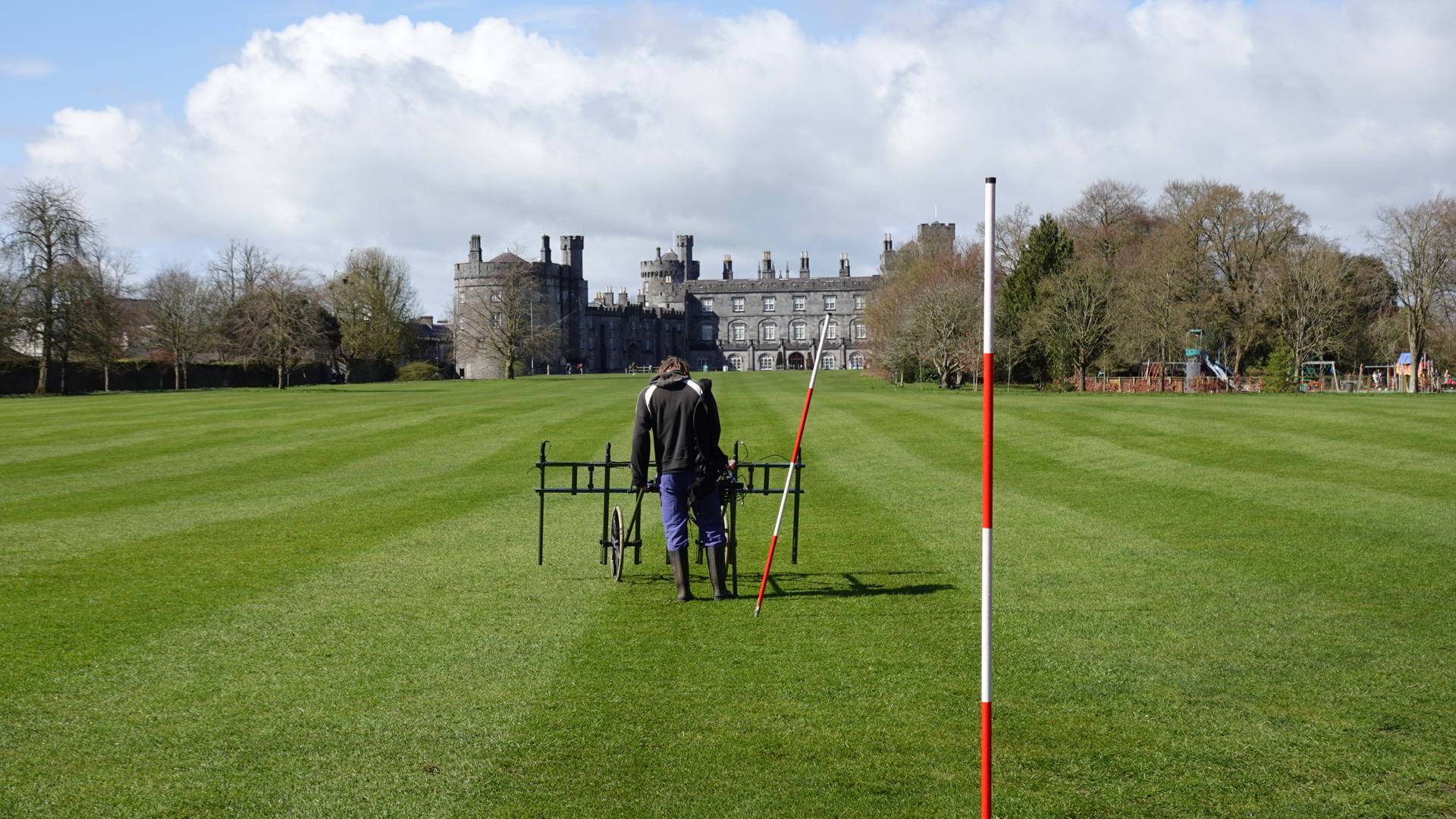
Photo: An archaeologist from The Discovery Programme undertaking geophysical survey using a magnetometer. Photo: The Discovery Programme: Centre for Archaeology and Innovation Ireland

Subscribe or register today to discover more from DonegalLive.ie
Buy the e-paper of the Donegal Democrat, Donegal People's Press, Donegal Post and Inish Times here for instant access to Donegal's premier news titles.
Keep up with the latest news from Donegal with our daily newsletter featuring the most important stories of the day delivered to your inbox every evening at 5pm.

This publication supports the work of the Press Council of Ireland and Office of the Press Ombudsman, and our staff operate within the Code of Practice of the Press Council. You can obtain a copy of the Code, or contact the Council, at www.presscouncil.ie, Lo-call 1800 208 080 or email: info@presscouncil.ie.