

Over 100 delegates attend landmark Kilkenny conference on rural mobility


Europe’s Rural Mobility Future: Setting Standards conference calls for Transport Poverty to be tackled at EU level
Over 100 people from across Europe have attended a landmark conference in Kilkenny focusing on rural mobility and transport.
Europe’s Rural Mobility Future: Setting Standards concluded with a call for transport poverty to be tackled and a community approach to designing mobility solutions. Delegates from Greece, Hungary, Spain, Bulgaria, France, Czechia and all over Ireland attended the event hosted by Renew Europe, the European Rural Mobility Network (ERMN) and Kilkenny LEADER Partnership.
Minister for Public Expenditure, Infrastructure, Public Service Reform and Digitalisation Jack Chambers addressed the conference, saying that mobility should not be judged by the services provided but the opportunities it unlocks.
“We need to reframe how we approach rural transport,” said Minister Chambers. “Spending more is important, but so is thinking differently about how we provide services. Locally designed services and community-led approaches have proven to be more sustainable in many cases.
“That’s precisely why the LEADER model remains so relevant. It has endured for more than three decades because it is built on a simple idea; local people understand local challenges better than distant administrations do. And that principle should inform how we think of our world mobility.”
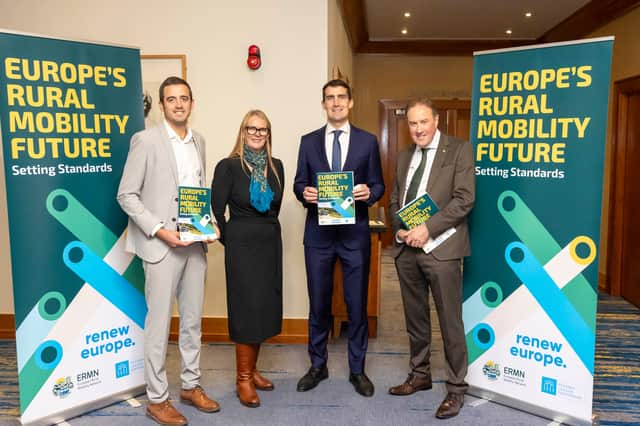
Andrea Lorenzini, president of the ERMN, a collective voice for rural transport campaigners, said the conference was focused on producing actionable policy recommendations to increase accessibility and connectivity of rural territories across Europe.
“Rural transport poverty is no longer acceptable,” he said. “We must acknowledge the fact that mobility is a social good and we need to set standards for it. Investments and funding streams for rural mobility need to be improved. It’s the same with policy. Transport policy is often made by those with an urban mindset but it is better when it comes from the ground up and with peer-to-peer comparisons.
“This is why the European Rural Mobility Network exists: we bring together practitioners, authorities, and policymakers across Europe to learn from current experiences and act for change, leading towards more accessible, inclusive, connected, and prosperous rural areas.”
This week also saw the publication of the National Transport Authority’s review of its Connecting Ireland plan.
“The results are encouraging,” Anne Shaw, Chief Executive of the NTA told the conference. “In 2025 alone, more than 11 million passenger journeys were made on Connecting Ireland services, demonstrating the very real demand that exists for public transport in rural Ireland when services are available, reliable and accessible.
“These figures tell an important story. They tell us that when we provide services, people use them, that rural communities want better connectivity. And they tell us that public transport can play a central role in supporting vibrant and sustainable rural communities.”
The theme of the conference was Setting Standards, and speakers from Portugal and Hungary outlined how these countries have begun implementing mandatory services for rural areas.
“There is already a precedent for minimum service levels here in Ireland,” said Declan Rice, CEO of Kilkenny LEADER Partnership. “Irish primary school children living 3.2km or more from a school are entitled to a place on a school bus. A similar standard could be applied to proximity to services such as healthcare.”
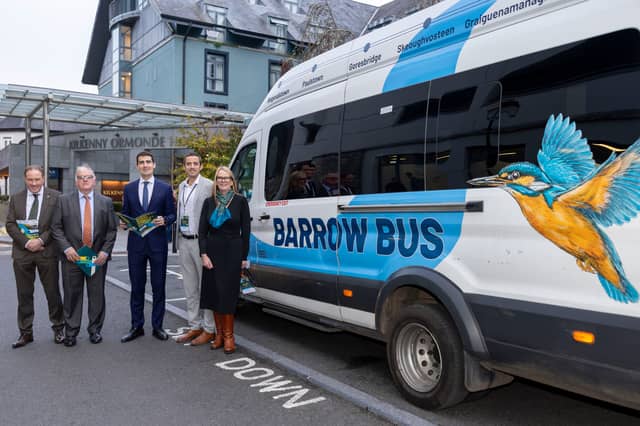
Kilkenny LEADER Partnership has conducted action-research projects to gather data on new services in currently unserved areas, with recent pilots carried out in the Lingaun Valley and Barrow Valley.
“Both our Lingaun Loop and Barrow Bus services have proved to be of huge social value,” added Mr. Rice. “They were designed, in large part, to cater to tourists but like many such services, they proved to have higher passenger numbers from the local area.”
The event concluded with a call for smart ways to tackle transport poverty at EU level and a bottom-up approach from local communities on how to design the best mobility solutions for their area.